
There are moments when social service is not about a grand event, a donation drive, or a public campaign.
Sometimes, social service begins with noticing one person who has been forgotten.
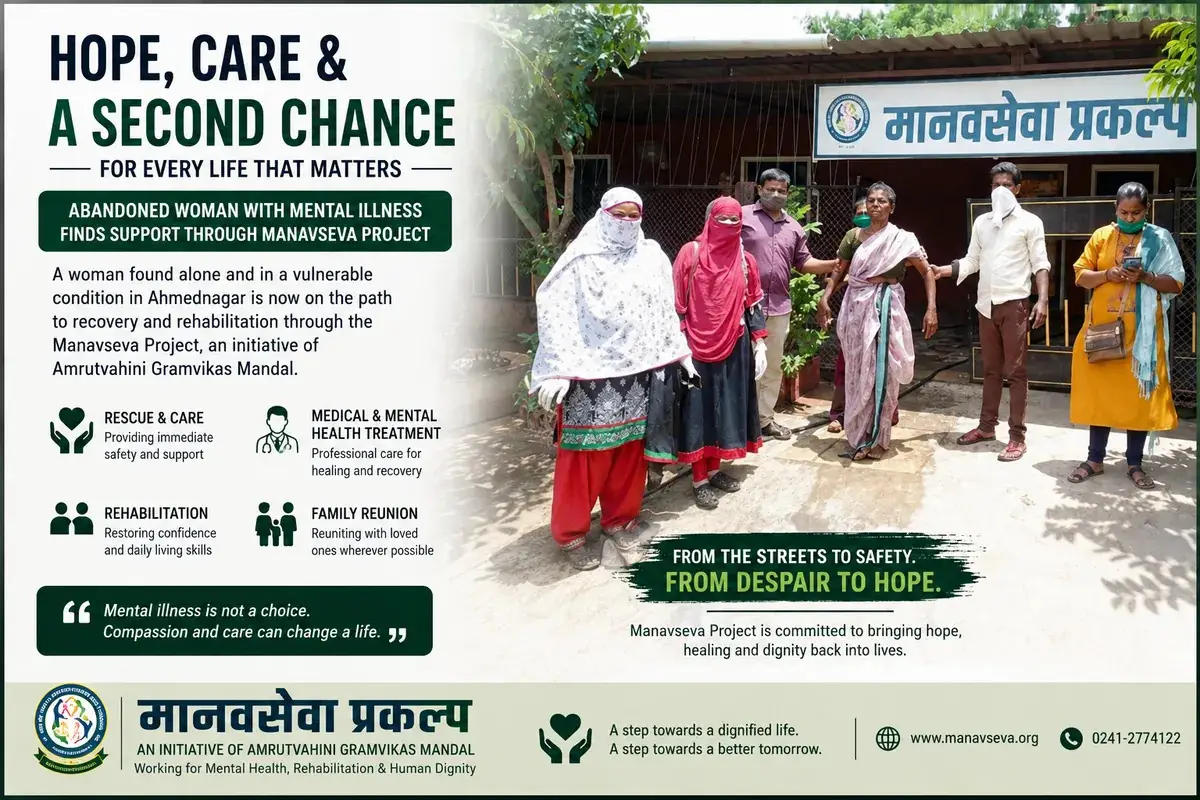
A woman found wandering alone in the Chandni Chowk area of Ahmednagar was reportedly struggling with mental illness and living in extremely difficult circumstances. Unable to properly care for herself and suffering from physical discomfort and injuries, she was in urgent need of care, protection and medical attention.
Instead of allowing her to remain on the streets, she was brought into the care of the Manavseva Project, operated by Amrutvahini Gramvikas Mandal, where efforts for her treatment and rehabilitation began.
Her story represents something much larger than one individual case.
It highlights the importance of mental health care, compassion, rehabilitation and restoring human dignity to people who have been pushed to the margins of society.
From the Streets to a Place of Care
According to the newspaper report, the woman was found in the Chandni Chowk area of Ahmednagar.
She was in a vulnerable condition. Her clothing and physical appearance reflected the difficult circumstances she had been living through. She was also experiencing physical problems, including injuries to her hands.
Living with mental illness without family support or adequate care can make even the simplest aspects of daily life extremely difficult.
For many people living on the streets, the problem is not simply homelessness.
It can involve a combination of:
- Mental health challenges
- Physical illness and injuries
- Lack of family support
- Lack of food and shelter
- Social isolation
- Difficulty accessing medical treatment
- Loss of personal identity and dignity
- Vulnerability to exploitation and abuse
This is why rehabilitation requires much more than simply providing temporary shelter.
It requires patience, medical care, emotional support and a safe environment.
A Helping Hand Through the Manavseva Project
Through the efforts of the Bhíngar Camp Police Station, the woman was brought into the Manavseva Project, operated by Amrutvahini Gramvikas Mandal.
The project works with people affected by mental illness who are living without adequate family or social support.
Once an individual enters such a rehabilitation environment, the journey does not end with admission.
It is only the beginning.
The objective is to understand the person's condition, provide appropriate care and work toward recovery and rehabilitation.
For this woman, the process of receiving care has begun under the guidance of mental health professionals and the dedicated team associated with the Manavseva Project.
Mental Health Rehabilitation Is About More Than Treatment
Mental illness can affect a person's ability to communicate, make decisions, maintain relationships and care for themselves.
When someone is also homeless or separated from their family, these challenges can become even more severe.
That is why mental health rehabilitation needs a holistic approach.
A meaningful rehabilitation process can involve:
1. Safe Accommodation
The first requirement is a safe and stable environment where the individual is protected from the dangers of living on the streets.
2. Medical Attention
Physical health problems and injuries must be identified and treated alongside mental health concerns.
3. Mental Health Care
Professional assessment and appropriate treatment can play an important role in stabilizing a person's mental health.
4. Emotional Support
People who have spent long periods without family or social support may require patience, understanding and consistent human connection.
5. Personal Care
Basic hygiene, nutrition, clothing and daily care are important parts of restoring health and confidence.
6. Rehabilitation
The long-term objective is to help the individual regain stability and, wherever possible, return to a more independent and dignified life.
7. Family Tracing and Reintegration
Where appropriate and possible, efforts can be made to identify the person's family and facilitate reunification.
The Human Side of Rehabilitation
Behind every rehabilitation case is a human story.
A person who appears confused or distressed on a street is not simply "a homeless person."
They may be someone's mother.
Someone's sister.
Someone's daughter.
Someone's friend.
Someone who once had a home, relationships, dreams and responsibilities.
Mental illness, difficult circumstances and social isolation can gradually separate a person from all of these things.
The role of organizations working in mental health rehabilitation is therefore not only to treat an illness.
It is also to restore a person's connection with humanity.
The Importance of Police and Community Support
The rehabilitation journey in this case also demonstrates the importance of cooperation between different parts of society.
The involvement of the Bhíngar Camp Police Station helped facilitate the woman's movement from a vulnerable situation on the street toward a safer rehabilitation environment.
This kind of cooperation can make a significant difference.
Police personnel, healthcare professionals, NGOs, social workers, volunteers and community members can each play an important role when vulnerable individuals are identified.
A coordinated approach can help ensure that people experiencing severe mental health difficulties are connected with appropriate support instead of being left without assistance.
Women Living With Mental Illness Need Special Attention
Women experiencing homelessness and mental illness can face additional vulnerabilities.
Without a safe environment, they may be exposed to physical danger, exploitation, neglect and further deterioration of their health.
Providing a protected environment where women can receive medical attention and basic care is therefore extremely important.
The Manavseva Project's work in supporting vulnerable individuals demonstrates the importance of creating spaces where people can receive care without judgment.
The Role of Compassion in Mental Health
One of the biggest challenges surrounding mental illness is stigma.
People experiencing mental health problems are sometimes misunderstood, ignored or treated differently because of their condition.
This can make them even more isolated.
But mental illness should be approached with the same compassion that we extend to physical illness.
A person with a mental health condition deserves:
Care.
Treatment.
Safety.
Respect.
Patience.
Dignity.
And, whenever possible, a pathway back to family and society.
A Rehabilitation Journey Begins With One Small Step
For the woman found in Ahmednagar, being brought into the Manavseva Project represents an important first step.
Her rehabilitation journey may involve many stages.
There may be challenges.
There may be days when progress is slow.
But having access to a safe environment and professional support creates something that was missing while she was alone on the streets:
Hope.
Hope that her physical condition can improve.
Hope that her mental health can be supported.
Hope that her identity or family may eventually be discovered.
And hope that she can once again experience a life of dignity.
Manavseva Project: Working Towards Dignity and Rehabilitation
The Manavseva Project, operated by Amrutvahini Gramvikas Mandal, represents a humanitarian approach to supporting people affected by mental illness and social vulnerability.
Its work focuses on bringing people who are in distress into an environment where they can receive care, treatment and rehabilitation.
The broader philosophy behind such work is simple:
No person should be considered worthless simply because they are struggling with mental illness or have been abandoned by society.
Every person deserves an opportunity to recover.
Every person deserves to be treated with dignity.
And every person deserves the possibility of reconnecting with their family and community.
From Neglect to Care, From Isolation to Hope
The story of this woman is a reminder that social change does not always begin with something enormous.
Sometimes it begins when someone stops.
Someone notices.
Someone calls for assistance.
Someone opens a door.
And someone says:
"This person needs help."
From that moment, a forgotten individual can begin a journey toward recovery.
The Manavseva Project's work demonstrates why mental health rehabilitation services are so important for communities across Maharashtra and India.
As awareness around mental health continues to grow, society must also recognize the importance of reaching people who are unable to seek help for themselves.
Building a More Compassionate Society
A truly developed society is not measured only by its infrastructure, economy or technology.
It is also measured by how it treats its most vulnerable people.
People living with mental illness.
People without homes.
People separated from their families.
People who have lost their way.
And people who can no longer ask for help themselves.
Supporting these individuals is not merely charity.
It is human responsibility.
The story of this woman from Ahmednagar is therefore more than a newspaper report.
It is a reminder that behind every vulnerable person is a human being who deserves to be seen.
And sometimes, being seen is the first step toward being saved.
About the Manavseva Project
The Manavseva Project of Amrutvahini Gramvikas Mandal works toward supporting vulnerable individuals affected by mental illness through care, treatment and rehabilitation.
The project's work reflects a commitment to creating a safer and more compassionate environment for people who may otherwise remain neglected or without support.
Through collective efforts involving social workers, healthcare professionals, police authorities, volunteers and the wider community, initiatives like these can contribute toward building a society where mental illness is met with understanding rather than stigma, and vulnerability is met with compassion rather than neglect.
A Message for Society
If you encounter a person experiencing severe mental distress or living in an extremely vulnerable condition, do not ignore them.
Do not assume that they simply "choose" to live that way.
Mental illness can affect a person's ability to seek help independently.
Instead, where appropriate, connect them with local authorities, qualified healthcare professionals or organizations equipped to provide mental health and rehabilitation support.
A small intervention can potentially change the direction of an entire life.
Help Us Reach More Villages
Your support powers our healthcare, education, and women-empowerment programs across rural Maharashtra.
Support Our Work